
1. The Primer
Wall Street capped off May by securing a historic ninth consecutive weekly gain for the S&P 500, even as late-day Market-on-Close (MOC) sell imbalances and highly volatile US-Iran geopolitical headlines triggered defensive positioning. Despite the underlying structural bid, institutional players are tread-water cautious as conflicting narratives over a Middle East memorandum of understanding and cooling AI spend expectations dominate the overnight thesis.
2. The Macro Field
While the domestic macro calendar remained relatively quiet, international developments stole the spotlight as Canada unexpectedly slipped into a technical recession for the first time since 2020, driven by weak business and government spending in Q1. On the central bank front, the Fed’s Schmid offered a nuanced take on technology, noting some evidence that AI is currently depressing hiring rather than driving outright firing. Meanwhile, the overarching macro narrative was dominated by intense, fast-moving geopolitical negotiations between Washington and Tehran; despite Treasury Secretary Bessent outlining scenarios ranging from a slow lifting of the blockade to kinetic action, conflicting reports from Iranian state media and President Trump regarding the destruction of uranium and the administration of the Strait of Hormuz kept risk premiums highly sensitive.
3. The Intraday Edge
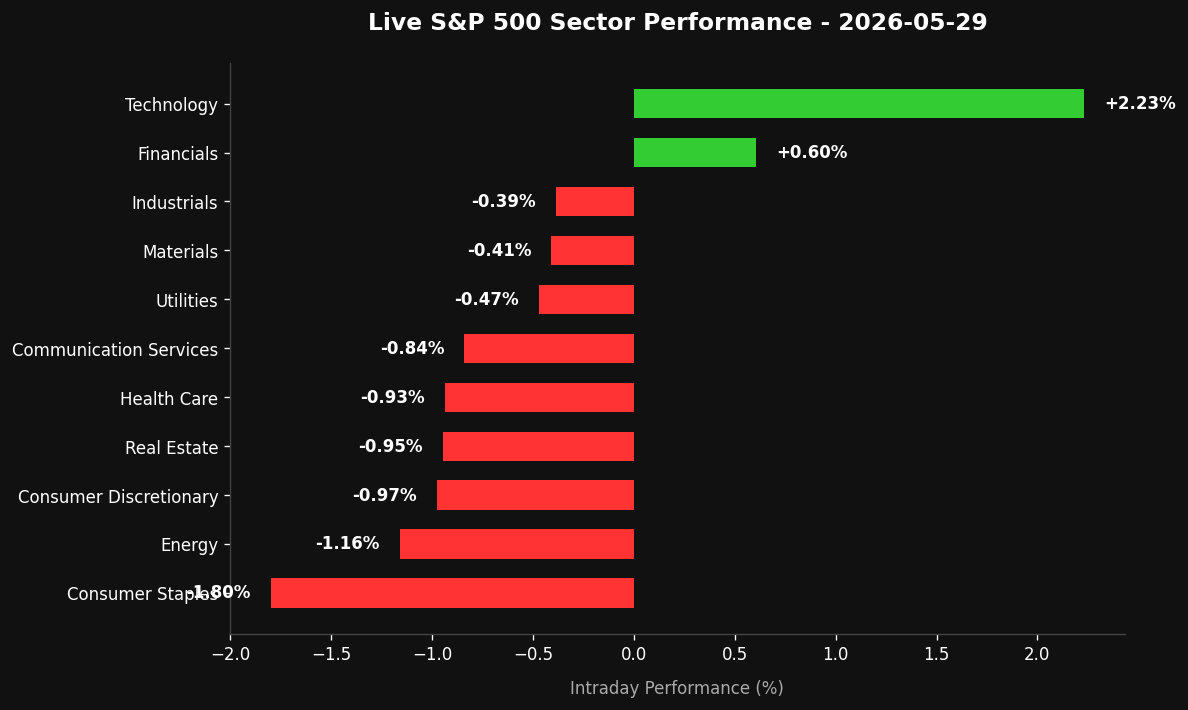
Institutional flow at the closing bell revealed a distinct defensive tilt, characterized by a hefty Market-on-Close (MOC) sell imbalance of -$966 million for the S&P 500 and -$920 million across the Magnificent Seven, contrasted by a modest +$375 million buy imbalance in the Dow. This late-day distribution aligns with emerging caution in the tech sector, where multiple executives reported plans to scale back AI capital expenditures, casting a shadow over high-flying semiconductor names despite massive historical wins like the AMD 5/29 450c options print. Key levels to monitor heading into next week include the psychological support on the S&P 500 to sustain this nine-week winning streak, alongside crude oil and defense-related equities which remain highly sensitive to military posturing near the Strait of Hormuz and reports of air defense activity near Iran’s Qeshm Island.
4. The Execution (Psychology)
In a market driven by headline-heavy geopolitical ping-pong—where official statements from Washington are instantly contradicted by state media in Tehran—the elite trader’s primary edge is not speed, but filter capacity. Succumbing to the “FOMO” of trading unconfirmed geopolitical leaks is a rapid path to capital destruction; instead, high-performance execution demands that you wait for the market’s structural reaction at key technical levels rather than trying to front-run the news. Protect your capital, recognize when the tape is dominated by noise rather than clean institutional trend-following, and maintain the discipline to sit on your hands when the risk-to-reward ratio is skewed by headline volatility.
5. Bottom Line
Lock in profits from the historic nine-week run, keep position sizes tight against overnight geopolitical headline risk, and prepare for a potential rotation out of overextended AI-beta names into defensive value if capital expenditure cooling becomes a broader industry trend.
Leave a Reply