Edge & Execution: Pre-US Session Briefing – April 15, 2026
1. The Primer
Geopolitical tensions remain a dominant force, with Middle East ceasefire rumors juxtaposed against IMF warnings of escalating global debt and persistent inflation risks. Wall Street opens into a complex narrative of central bank caution, divergent economic signals, and a clear, sustained demand surge in the AI sector.
2. The Macro Field
The Forex Factory narrative is dominated by a sobering IMF Fiscal Monitor report, projecting global government debt to reach 100% of GDP by 2029—a year earlier than anticipated—and potentially 117-121% under adverse Middle East conflict scenarios. The US and China are cited as primary drivers, with the IMF noting “no debt consolidation plan in sight” for the US, and interest payments sharply rising. Geopolitically, an Iranian source suggests a one-week ceasefire in Lebanon could be announced tonight, while President Trump claims China has agreed not to send weapons to Iran, offering a glimmer of de-escalation amidst ongoing regional instability and a US-sanctioned ship passing through Hormuz.
Central bank commentary remains cautious: Fed’s Barr highlights a “two-speed” economy and the need to manage shocks, while Hammack acknowledges a “tough time” for policy-making, noting high energy prices could either fuel inflation or weigh on growth. ECB’s Kazaks is content with stable core inflation but remains non-committal on April action, yet “nothing against bets on two hikes starting June.” US March Import Prices rose 0.8% M/M, significantly below the 2.0% estimate, but the spike was driven almost entirely by a +9.4% jump in petroleum, indicating energy remains a key inflationary pressure point.
3. The Intraday Edge
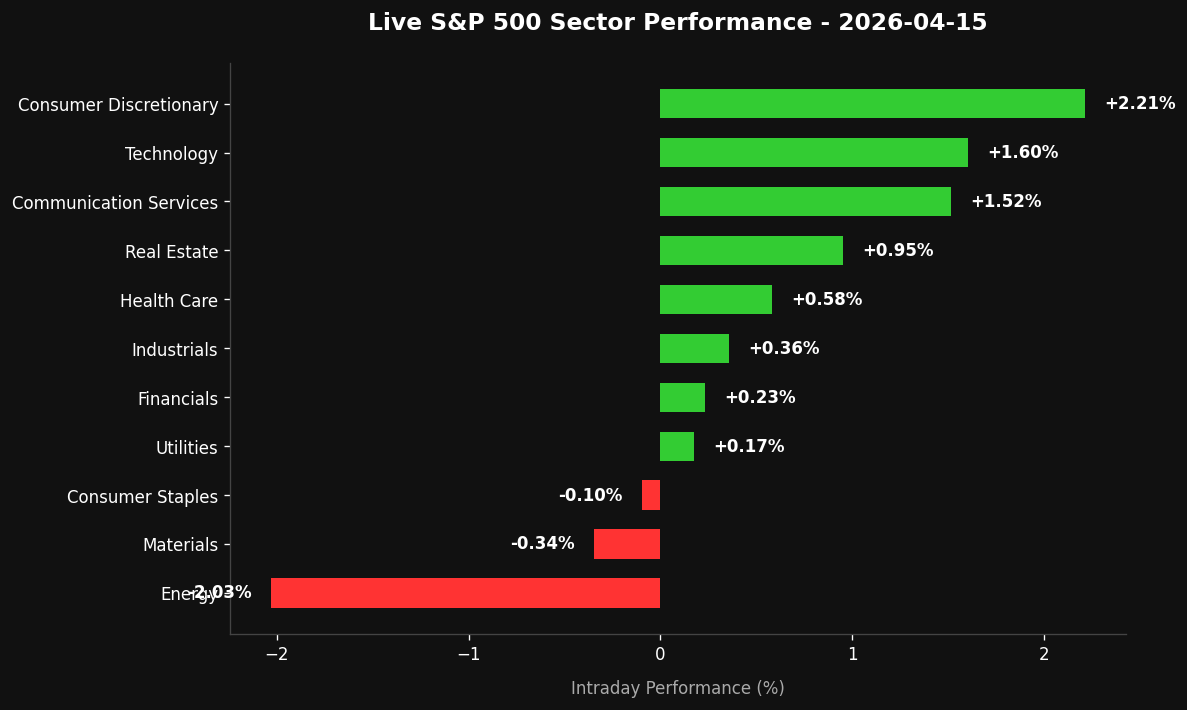
Institutional X sentiment reveals a bifurcated market. The **Semiconductor/AI** sector continues to exhibit robust underlying strength, with ASML’s CEO stating that AI investments translate into “a lot of demand for advanced memory, logic,” and that “supply won’t meet demand in the foreseeable future,” with customers “sold out for 2026.” This signals persistent tailwinds for key players in the AI supply chain. Conversely, the **Energy** sector remains highly sensitive to geopolitical developments and crude price action, with rising gas prices already threatening to offset tax refund boosts for consumers, despite resilient discretionary spending in March.
**Key Setups:** Look for continued strength in AI-centric tech names, particularly on any pre-market dips, as the long-term demand narrative is firmly intact. Energy stocks may see volatility based on Middle East headlines; a confirmed ceasefire could temper some of the recent upside, while renewed tensions would reignite it. The **Real Estate** sector warrants caution, with US existing home sales falling to their lowest since June 2025. In fixed income, the UK’s 10Y Gilt sale at the highest yield since 2008 is a stark reminder of global debt concerns and could pressure US Treasury yields. Avoid broad-market directional bets without clear catalysts; instead, focus on high-conviction, sector-specific plays.
4. The Execution (Psychology)
Today demands a mental model of **Adaptive Discernment**. The market is awash with conflicting signals: geopolitical de-escalation hopes versus persistent debt warnings, sector-specific booms versus broader economic stagnation. Chasing every headline or reacting impulsively to every data point will lead to chop. Instead, cultivate the discipline to filter noise, identify confirmed trends (like AI demand), and respect the macro headwinds (IMF debt, inflation persistence). Prioritize capital preservation by sizing positions appropriately and maintaining strict stop-loss protocols. Your edge today comes from patience and precision, not aggression.
5. Bottom Line
Navigate the pre-US session with a focus on selective engagement: capitalize on the undeniable structural demand in AI-related tech, remain highly vigilant on energy due to geopolitical flux and its inflationary impact, and exercise extreme caution in broader market plays given the IMF’s dire debt warnings and central bank uncertainty. Risk management is paramount.

Leave a Reply